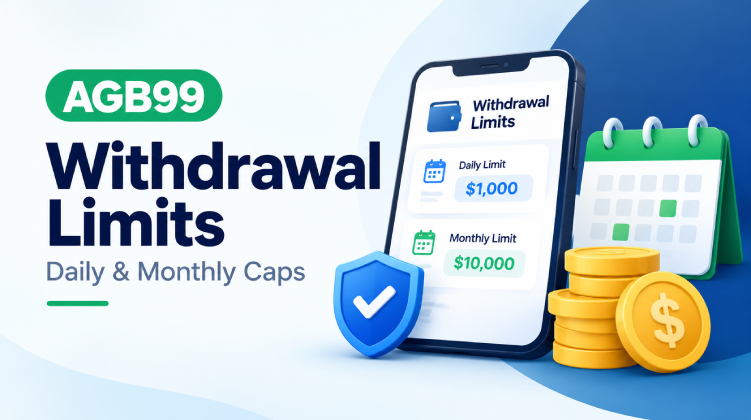
AGB99 Withdrawal Limits: Daily and Monthly Caps
AGB99 withdrawal limits are important to understand before requesting any payout because daily and monthly caps can affect how much a user may withdraw within a specific period. These limits may depend on account status, payment method, verification requirements, transaction rules, and other conditions. Since withdrawal policies can change, users should always check the applicable terms shown on their account before making a withdrawal request.
For anyone using an online gaming or betting platform, understanding withdrawal limits is just as important as understanding deposits. A user may have a sufficient balance but still be unable to withdraw the entire amount at once if a transaction or periodic limit applies. Knowing how daily and monthly limits generally work can make financial planning easier and help users avoid unnecessary confusion.
What Are AGB99 Withdrawal Limits?
AGB99 withdrawal limits refer to restrictions that may determine how much money can be withdrawn during a particular period. A limit can apply to a single transaction, a day, or a longer period such as a month.
For example, if a platform establishes a daily withdrawal ceiling, a user may need to divide a larger eligible balance into multiple withdrawals over different days. Similarly, a monthly cap could affect users who regularly request large payouts.
Withdrawal limits are normally designed to help platforms manage payment processing, account security, financial controls, and transaction monitoring. They can also vary according to the payment channel selected.
It is important not to assume that one limit applies universally to every account. The amount available for withdrawal may depend on the specific conditions displayed to the individual user.
Why Daily Withdrawal Caps Matter
A daily withdrawal cap determines the maximum amount that can potentially be withdrawn within a defined 24-hour or platform-specific daily period.
This matters most when a user has a balance larger than the permitted daily withdrawal amount. Instead of receiving the complete amount in one transaction, the user may need to make additional requests after the daily limit resets.
Consider a simple example. Suppose an account has an eligible balance of $2,000 but the applicable daily withdrawal limit is $1,000. The user might be able to request $1,000 first and then submit another eligible request after the relevant daily period resets.
The example is only an illustration; it does not represent a confirmed AGB99 limit.
Daily limits can also be affected by the payment method. Bank transfers, electronic payment services, and other channels may have different processing rules. Therefore, checking the withdrawal screen before submitting a request is essential.
Understanding Monthly Withdrawal Caps
A monthly withdrawal cap works differently from a daily limit. Instead of restricting withdrawals during a single day, it establishes a maximum amount that may be processed during a monthly period.
Monthly limits can become particularly relevant for users who make frequent withdrawals. Someone making small occasional withdrawals might never reach the cap, while a user requesting larger or more frequent payouts could encounter it.
A monthly cap may also operate independently from a daily limit. For example, a hypothetical platform could allow a certain amount per day while also restricting the total amount processed during a calendar month.
Because the exact rules can vary, users should distinguish between:
- Single-transaction limits
- Daily withdrawal limits
- Weekly limits, where applicable
- Monthly withdrawal limits
- Payment-provider limits
Understanding these differences makes it easier to plan withdrawals without assuming that one restriction automatically explains every declined request.
Factors That Can Affect Withdrawal Limits
Several factors may influence the amount that can be withdrawn from an AGB99 account. The exact conditions should be confirmed through the platform’s current account information and applicable terms.
Account Verification
Verification can be an important part of online financial transactions. A platform may require users to complete certain identity or account checks before processing withdrawals.
An incomplete verification process may result in additional restrictions, delays, or a temporary inability to withdraw.
Users should therefore make sure that their account information is accurate and that any required verification steps have been completed.
Payment Method
The selected payment method can also affect withdrawal conditions. Different payment providers may have their own transaction ceilings, processing schedules, and eligibility requirements.
A withdrawal limit shown for one payment option should not automatically be assumed to apply to another.
Account Status
Some platforms may apply different transaction conditions depending on account status or other account-related factors. Users should review the information displayed within their own account rather than relying on figures found in older articles or third-party discussions.
Transaction History
A platform may consider transaction activity when processing financial requests. Large or unusual transactions can sometimes require additional checks before completion.
This does not necessarily mean a withdrawal will be rejected. It simply highlights why users should maintain accurate account information and understand the platform’s applicable transaction procedures.
Daily vs. Monthly Withdrawal Limits
The difference between daily and monthly limits can be summarized easily.
| Limit Type | What It Controls | Why It Matters |
| Single Transaction | Amount requested at one time | May require multiple requests |
| Daily Cap | Amount withdrawn during a daily period | Can delay larger withdrawals |
| Weekly Cap | Amount processed during a week | May affect frequent withdrawals |
| Monthly Cap | Total amount during a monthly period | Important for high-volume withdrawals |
| Payment Method Limit | Amount supported by a payment channel | May vary between payment options |
These categories should not be treated as universal AGB99 figures. They explain the types of restrictions a user may encounter when reviewing withdrawal conditions.
How to Check Your Applicable AGB99 Limit
The safest way to determine the current withdrawal limit is to check the withdrawal section of the account being used.
Before submitting a request, users should examine the displayed information for details such as the minimum withdrawal amount, maximum permitted amount, processing conditions, and available payment methods.
It is also useful to check whether the displayed amount represents a single-transaction limit or a broader daily or monthly restriction. These terms can have very different meanings.
If the account interface does not clearly explain a restriction, users should review the platform’s current terms or contact the relevant customer-support channel for clarification.
What Happens If You Reach the Daily Limit?
Reaching a daily withdrawal limit does not necessarily mean that the balance has disappeared or that a withdrawal is permanently unavailable. It may simply mean that additional withdrawals cannot be processed until the applicable limit resets.
For example, a user might request an eligible amount in the morning and discover later that another request cannot be submitted because the daily allowance has already been reached.
In such a situation, the user should avoid repeatedly submitting unsuccessful requests. Instead, checking the displayed limit and reset period can provide a clearer understanding of when another request may become possible.
The reset period is particularly important. A “daily” limit does not always mean that the limit resets at midnight in every system. Platform-specific rules determine how the relevant period is calculated.
What Happens When a Monthly Cap Is Reached?
A monthly cap can create a similar situation over a longer period. Once the applicable monthly allowance has been reached, additional withdrawals may have to wait until the next qualifying period.
This is especially relevant for users who regularly move money from an account rather than making occasional withdrawals.
Keeping track of previous withdrawals can help users understand how much of an applicable allowance has already been used. However, the platform’s own transaction records should be treated as the primary reference because manual calculations may not account for cancellations, pending transactions, reversals, or provider-specific rules.
Withdrawal Limits and Processing Times
Withdrawal limits and processing times are separate issues.
A user can submit a withdrawal that falls within the applicable limit and still experience processing time because the payment method, verification process, transaction checks, or financial institution may require additional time.
This distinction is useful because users sometimes interpret a pending withdrawal as evidence that they have exceeded a limit. That is not necessarily the case.
A pending transaction can have several possible explanations, so users should review the transaction status and any available account messages before assuming that the withdrawal limit is responsible.
Common Mistakes Users Should Avoid
Understanding withdrawal limits is easier when several common mistakes are avoided.
One frequent mistake is relying on outdated information. Online platforms can change payment conditions, transaction limits, and eligibility requirements, meaning an amount published previously may no longer apply.
Another mistake is confusing the maximum withdrawal amount with the available account balance. Having enough money in an account does not automatically mean the entire balance can be withdrawn in one transaction.
Users should also avoid repeatedly submitting requests after a limit has been reached. Multiple unsuccessful attempts can create unnecessary confusion and may not make the restriction disappear.
Finally, users should carefully distinguish between platform limits and payment-provider limits. A transaction can be affected by either one.
Practical Example of Withdrawal Planning
Imagine a hypothetical user has an eligible balance of $3,000. The applicable account rules allow a maximum of $1,000 per withdrawal, while the relevant payment provider imposes another restriction.
Instead of assuming the entire $3,000 can be transferred immediately, the user should first check:
- The maximum amount permitted per transaction.
- The applicable daily withdrawal ceiling.
- Whether a monthly cap exists.
- The selected payment method’s own restrictions.
- Whether account verification is complete.
- Whether any previous withdrawal remains pending.
This approach provides a much clearer picture of what can actually be processed.
Again, the figures in this example are hypothetical and should not be interpreted as confirmed AGB99 limits.
How to Prepare Before Making a Withdrawal
A little preparation can reduce avoidable problems. Before requesting a withdrawal, users should review their account balance, confirm their payment information, and check the currently displayed withdrawal conditions.
It is also sensible to verify whether there are pending transactions. A pending withdrawal may affect the amount that can be requested next, depending on the platform’s rules.
Users should keep records of completed transactions as well. Maintaining a basic history can make it easier to identify how much has already been withdrawn during a particular period.
Most importantly, users should never assume that information from an old article, social media post, or forum automatically represents the current rules.
Why Withdrawal Limits Can Change
Withdrawal policies can change for several reasons. Payment providers may modify their own transaction requirements, platforms may update financial procedures, and security or compliance processes can evolve over time.
As a result, an amount that was available previously may not remain available indefinitely.
This is why current account information is more useful than relying exclusively on historical figures. Users planning a large withdrawal should pay particular attention to the conditions displayed immediately before submitting the request.
Responsible Financial Planning
Withdrawal limits should also be considered as part of responsible financial planning. Users should only participate with money they can afford to lose and should avoid treating gaming activity as a guaranteed source of income.
A withdrawal limit does not increase the value of an account balance, nor does it guarantee that funds will be available immediately. It is simply a transaction condition that determines how withdrawals may be processed.
Keeping personal spending limits separate from platform withdrawal limits is therefore important. A user should establish a personal budget independently of any promotional offer, potential winnings, or expected withdrawal.
Frequently Asked Questions About AGB99 Withdrawal Limits
Does AGB99 have a daily withdrawal limit?
A daily withdrawal limit may apply depending on the current account and payment conditions. Users should check the withdrawal section of their account for the applicable amount rather than relying on an unverified fixed figure.
Is there a monthly withdrawal cap?
A monthly cap may apply under certain conditions, but the exact amount and calculation period should be confirmed through the current account terms.
Can I withdraw my entire balance at once?
Not necessarily. A single-transaction limit, daily cap, payment-provider restriction, or other condition may prevent the entire eligible balance from being withdrawn in one request.
Why was my withdrawal amount restricted?
Possible reasons include a transaction limit, payment-method restriction, incomplete verification, pending transactions, or other account conditions. The specific reason should be determined from the account’s current withdrawal information.
Do withdrawal limits reset every midnight?
Not necessarily. The definition of a daily period and its reset time depends on the platform’s applicable rules. Users should check the displayed terms rather than assume a universal reset time.
Can payment methods have different withdrawal limits?
Yes. Payment providers can have different transaction requirements and restrictions. Therefore, the limit shown for one payment option should not automatically be applied to another.
Final Thoughts on AGB99 Withdrawal Limits
AGB99 withdrawal limits are an important consideration for anyone planning to move funds from an online gaming account. Daily and monthly caps can influence how much can be requested at a particular time, while transaction limits, payment methods, verification requirements, and processing procedures can create additional conditions.
The most reliable approach is to check the current withdrawal information available within the account before submitting a request. Rather than depending on fixed figures from older content, users should confirm the applicable limit, reset period, payment method requirements, and transaction status at the time of withdrawal.
Understanding these details can make the withdrawal process more predictable and help users avoid unnecessary failed requests or misunderstandings. Most importantly, withdrawal limits should be viewed as transaction rules—not as a guarantee of payment speed or availability. Careful account management, accurate information, and responsible financial decisions remain essential whenever money is involved.