
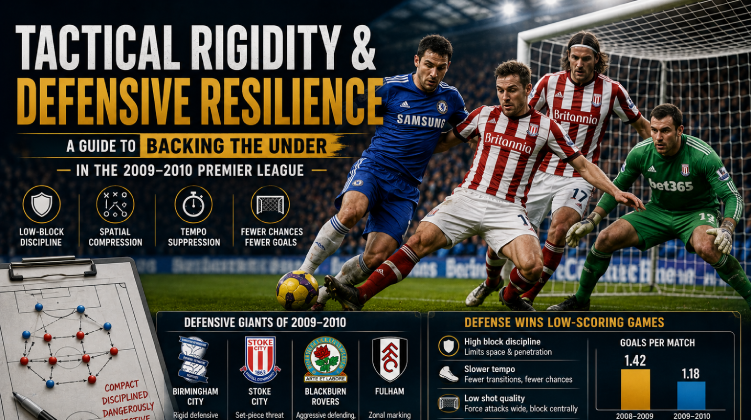
Tactical Rigidity and Defensive Resilience: A Guide to Backing the Under in the 2009–2010 Premier League
Wagering on the under in goal-total markets demands an objective understanding of how defensive systems actively throttle match tempo rather than relying on fortunate finishing variance. The 2009–2010 Premier League season presents an exceptional case study in defensive organization, where multiple mid-table and upper-tier teams built their tactical identities around low-block discipline, spatial compression, and physical dominance in the defensive third. While the title race generated headlines through record-breaking offensive displays from elite sides, the broader league ecosystem featured persistent, structurally sound defensive units that systematically rendered standard 2.5-goal lines inefficient. Isolating the mechanics behind these low-event structures enables bettors to evaluate under-goal selections through tactical logic rather than speculative hope.
The Tactical Architecture of Low-Event Football
Low-scoring matches occur primarily when a defending side successfully dictates where and how an opponent can circulate possession. In 2009–2010, several managers abandoned high-pressing experiments in favor of deep, horizontally aligned four-man backlines protected by two disciplined central defensive midfielders. This setup eliminated vertical passing channels into the penalty area, forcing attacking teams to cycle the ball across the perimeter without creating genuine penetration. By conceding sterile possession in non-threatening areas, rigid teams intentionally drained active match time, drastically decreasing the total volume of high-probability scoring opportunities generated across ninety minutes.
Spatial Compression Mechanisms in the Defensive Third
Spatial compression functions by minimizing the vertical distance between a team’s defensive backline and its central midfield pivot, typically holding this gap to under fifteen meters. When an attacking side approaches the final third against this structure, the defending unit shifts laterally as a cohesive block, cutting off shooting angles and forcing attacking players toward the touchlines. This structural congestion reduces expected goals per shot attempt, ensuring that even sustained territorial pressure yields low-probability speculative strikes rather than clear-cut conversions.
Identifying Systematic Under-Goal Generators Across the Mid-Table
Certain clubs in the 2009–2010 campaign established structural conditions that consistently suppressed match scoring regardless of the opposition’s attacking caliber. These teams deliberately compromised their own offensive transition speed to maintain defensive numerical superiority behind the ball at all times. Evaluating these specific clubs clarifies why pre-match analysis must weigh structural intent far more heavily than individual attacking talent.
- Birmingham City: Maintained rigid defensive banks under Alex McLeish, conceding fewer than one goal per match on average at home while prioritizing clean sheets over forward expansion.
- Stoke City: Leveraged physical aerial dominance and slow set-piece restarts at the Britannia Stadium to disrupt match flow and minimize open-play transition speed.
- Blackburn Rovers: Deployed aggressive central fouling and aerial box clearances under Sam Allardyce to break up technical passing sequences and depress overall shot quality.
- Fulham: Utilized Roy Hodgson’s strict zonal marking system to deny central penetration, producing methodically paced contests with minimal penalty-box chaos.
The tactical execution of these four clubs demonstrates that defensive consistency is an active, structured strategy rather than an accidental byproduct of poor finishing. When both fullbacks are instructed to stay deep and wide midfielders focus primarily on defensive tracking, open-play goal probability collapses across both ends of the pitch. Recognizing these deliberate tactical constraints allows market participants to identify fixtures where the baseline probability of a low-scoring outcome heavily exceeds standard market expectations.
Evaluating Shot Suppression Versus Box Density Metrics
A common error among novice analysts is equating raw shot volume with offensive danger, failing to distinguish between perimeter efforts and central box penetration. During the 2009–2010 season, several elite defensive units routinely conceded fifteen or more total shots per match while maintaining exceptionally low goals-against averages. The difference lies in box density, where central defenders consistently block shooting lanes and contest aerial deliveries, turning seemingly heavy pressure into harmless, low-percentage attempts.
| Defensive Unit Profile | Primary Containment Method | Average Box Clearances Per Game | Impact on Standard 2.5 Total Line |
| Rigid Zonal Mid-Block (e.g., Fulham, Birmingham) | Compact central lines denying through-balls | High (>22 per match) | Heavy skew toward 0–0, 1–0, and 1–1 scorelines |
| Physical Low-Block Aerial Unit (e.g., Stoke, Blackburn) | Dominance of direct aerial crosses and set pieces | Extreme (>28 per match) | Severe suppression of open-play goal conversion rates |
| Elite Positional Possession (e.g., Manchester United) | Territorial dominance preventing opponent transitions | Moderate (12–16 per match) | Frequent low-event clean-sheet victories against lower-tier sides |
| Asymmetric Home-Only Fortresses (e.g., Burnley) | High-intensity early physical disruption at home | Variable (High home, Low away) | Under-total value confined strictly to home venue fixtures |
The categorized data reveals that effective defensive sides nullify goal expectancy by controlling the location and quality of opponent chances rather than eliminating shots entirely. When a low-block defense forces an attacking team to settle for long-range strikes or contested crosses, the probability of multiple goals materializing drops steeply. Analyzing the interaction between defensive containment styles and opponent shot profiles is therefore essential for pricing total markets with mathematical precision.
Goalkeeping Overperformance and Defensive System Synergy
A compact defensive system magnifies the effectiveness of an organizing goalkeeper by ensuring that incoming shots are predictable and taken under physical pressure. During the 2009–2010 campaign, goalkeepers operating behind structured backlines faced fewer unpressured one-on-one situations, which stabilized their save percentages and prevented high-variance defensive collapses. When goalkeeping consistency aligns perfectly with a manager’s spatial containment scheme, the likelihood of an unexpected high-scoring blowout diminishes significantly.
In situations where late lineup announcements confirm the absence of key defensive personnel, monitoring immediate odds recalibration across a professional website provides critical clarity on how the market evaluates the systemic loss. Reviewing sharp line movements and total adjustments via ยูฟ่าเบท enables analysts to verify whether defensive absentees genuinely compromise the team’s underlying structure or if oddsmakers are overreacting to individual player status.
The Fragility of Low-Goal Expectations Against Elite Counter-Pressing
Betting the under carries inherent systemic risks when a defensively minded team faces an elite opponent capable of aggressive counter-pressing. In 2009–2010, whenever a low-block team conceded an early goal to an opponent with rapid attacking transitions, their defensive containment plan collapsed immediately. Forced to abandon their deep shape to pursue an equalizer, these sides left vast spaces behind their backlines, transforming tightly contested low-event fixtures into rapid, multi-goal transition games that completely shattered under-total projections.
Market Mispricing and the Public Bias Toward Goal Totals
Recreational betting patterns consistently lean toward backing goals, creating structural market inefficiencies that favor disciplined under bettors. Casual participants naturally prefer anticipating offensive action and exciting finishes, which drives public money toward the over and artificially inflates total lines. This persistent psychological bias frequently leaves under 2.25 and under 2.5 lines priced with positive expected value in fixtures involving disciplined mid-table units.
When sports total markets offer limited pricing edge due to accurate bookmaker calibration on high-profile fixtures, examining probabilistic distributions across an alternative platform can reinforce the foundational discipline required to manage variance. Interacting with fixed-margin games on a casino online provides a clear mathematical reminder that long-term profitability relies strictly on exploiting positive expected value rather than chasing emotionally appealing outcomes.
Managing Downside Risk When Betting Defensive Low-Scoring Lines
A disciplined approach to backing under totals requires strict bankroll management to withstand the high-impact variance inherent in low-scoring football matches. Deflection goals, contentious penalty decisions, and early red cards can abruptly dismantle a flawless defensive performance, invalidating hours of tactical analysis in a matter of seconds. Utilizing fractional staking models and avoiding overexposure to single matchdays ensures that an analyst’s capital survives the inevitable short-term anomalies that occur in low-scoring sporting events.
Summary
Backing the under in the 2009–2010 Premier League was a logically sound strategy when applied to teams with established low-block structures, disciplined spatial compression, and predictable shot concessions. Defensive consistency in football is rooted in systematic tactical alignment rather than luck, making low-event dynamics quantifiable and exploitable. By identifying teams that deliberately suppress match tempo and recognizing the public’s perpetual bias toward goals, bettors can systematically uncover value in under-total markets while managing the operational variance of the sport.