
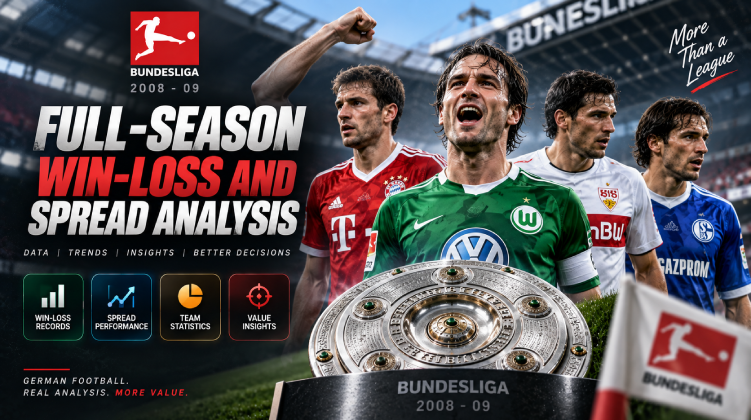
Deconstructing the Full-Season Win-Loss and Spread Records of the 2008-09 Bundesliga
Comprehensive post-season audits of domestic football campaigns often reveal that traditional league tables conceal deep statistical inefficiencies regarding how clubs performed against market expectations. The 2008-09 German Bundesliga season stands as a monumental dataset for analyzing how win-loss trajectories interacted with Asian handicap cover rates over a full thirty-four-match schedule. By contrasting absolute points earned with cover efficiency, analytical handicappers can isolate the structural variables that separated profitable betting assets from public traps, offering an applied blueprint for long-term football market evaluation.
The Macro-Level Divergence Between Table Standing and Spread Profitability
Absolute league standings measure outcomes based purely on three-point match victories, ignoring the margin of victory or the handicap expectations established by global bookmakers. During the 2008-09 campaign, this structural disconnect meant that finishing in the top four did not automatically translate into a positive return on investment for handicap bettors. Sportsbooks systematically shaded lines upward for famous clubs, forcing title contenders to win by wide margins to secure spread success.
This dynamic created an inverse relationship where several mid-table and defensive-minded outfits generated superior financial yields compared to traditional championship contenders. When market pricing relies heavily on historical reputation rather than real-time tactical efficiency, the resulting spread discrepancies produce long-term profit opportunities for analysts who evaluate performance through a strictly margin-oriented framework.
Comprehensive Full-Season Spread and Win-Loss Performance Audit
Evaluating the true financial profile of the entire eighteen-team division requires mapping out absolute competitive results against full-season handicap cover percentages.
The audited performance metrics across the complete thirty-four-match schedule illustrate how varied clubs distributed value between outright wins and spread covers:
| Club Name | Final Rank | Match Record (W-D-L) | Goal Difference | Spread Cover Rate (%) | Primary Market Classification |
| VfL Wolfsburg | 1st | 21-6-7 | +46 | 64.7% | Elite Margin Generator |
| Hertha BSC | 4th | 19-6-9 | +7 | 61.8% | Resilient Plus-Spread Asset |
| VfB Stuttgart | 3rd | 19-7-8 | +20 | 58.8% | Second-Half Momentum Cover |
| FC Schalke 04 | 8th | 12-11-11 | +10 | 44.1% | Chronic Under-Cover Favorite |
| Bayern Munich | 2nd | 20-7-7 | +29 | 41.2% | Overpriced Public Liability |
The statistical ledger confirms that raw win counts failed to predict handicap solvency. FC Schalke 04 and Bayern Munich both suffered severe spread failure rates despite capturing upper-mid-table and runner-up finishes, respectively, because their offensive conversion rates and defensive vulnerabilities could not support the heavy minus-handicaps demanded by the public market.
Wolfsburg’s Historical Consistency: The Benchmark for Full-Season Cover Rates
VfL Wolfsburg’s march to the 2008-09 championship was underpinned by an unmatched 64.7% handicap cover rate, driven by a rare combination of offensive volume and relentless home dominance. Felix Magath’s squad avoided the mid-season complacency that frequently plagues frontrunners, maintaining high physical intensity across all thirty-four rounds. Their ability to consistently clear -1.0 and -1.5 spreads at the Volkswagen Arena made them the single most reliable investment vehicle of the season.
The durability of Wolfsburg’s spread record stemmed from their tactical refusal to sit on leads. By maintaining high-tempo vertical transitions until the final whistle, they converted narrow one-goal leads into multi-goal routs, rewarding minus-handicap backers with steady, compounding returns that mirrored their ascent to the top of the German football hierarchy.
The Pitfalls of Backing Overpriced Giants Across Thirty-Four Matches
Analyzing full-season datasets illuminates the financial damage inflicted by backing traditional powerhouses that carry a permanent market tax. Bayern Munich and Werder Bremen commanded heavy betting volume throughout the year, forcing oddsmakers to inflate their minus-handicaps to levels that exceeded their actual defensive capabilities. Bayern’s defensive disorganization under Jürgen Klinsmann resulted in a 41.2% cover rate, meaning handicap bettors lost money on them over the course of the season despite twenty outright victories.
Fading these overvalued giants required identifying the precise structural tipping points where public sentiment detached from pitch reality. Because casual bettors continuously backed famous brands regardless of injury news or tactical friction, disciplined handicappers extracted consistent profit by taking plus-spreads against the heavyweights whenever their defensive transition metrics signaled impending vulnerability.
Tactical Correlates of Full-Season Spread Success
A deeper inspection of the full-season data reveals that high cover rates were not distributed randomly; they clustered tightly around specific tactical profiles.
Structural Pre-Conditions for Sustained Spread Coverage
When analyzing clubs that achieved a cover rate exceeding 55%, distinct structural commonalities emerge across their tactical execution:
- Spatial Compactness: Successful cover teams limited opponent central penetration, forcing low-probability shots from wide areas.
- Transition Efficiency: Squads that converted defensive recoveries into penalty box entries within four passes consistently beat spread expectations.
- Game-State Resilience: Teams maintaining aggressive tactical shapes when leading prevented opponents from launching uncontested late comebacks.
- Low Dependency on Individual Variance: Sides scoring via structured positional overloads posted more stable cover rates than teams relying on long-range speculative strikes.
These structural traits explain why defensive stalwarts like Hertha BSC and transition powerhouses like Wolfsburg sustained their high handicap yields from August through May.
Evaluating Market Adjustments and Closing Line Efficiency
A critical takeaway from auditing the 2008-09 season is observing how sportsbooks adjusted their pricing models as the campaign progressed. Early-season inefficiencies—such as the mispricing of Hoffenheim’s pressing system or Wolfsburg’s home dominance—gradually compressed as algorithmic models caught up to real-world performance metrics.
When reviewing how bookmaker lines evolved over the thirty-four rounds in response to mounting team data, utilizing a professional-grade betting platform illustrates how market friction operates; observing quote adjustments via แทงบอล ufa highlights the reality that sustaining profitability requires identifying emerging tactical shifts before oddsmakers fully incorporate them into baseline pricing models.
Managing Capital Through Volatile Relegation and Mid-Table Cycles
Full-season profitability is heavily influenced by how bettors navigate the turbulent waters of the relegation battle and mid-table variance. Teams fighting for survival often experience wild swings in performance, alternating between desperate defensive masterclasses and catastrophic spatial collapses when conceding early goals.
Whenever a bettor evaluates erratic mid-table outfits over an extended schedule, exploring auxiliary analytical tools on an interactive wagering destination provides essential risk mitigation; assessing derivative market trends through casino online demonstrates the practical utility of diversifying away from full-season match handicaps toward team total bounds or alternative Asian lines when squad fatigue sets in during the grueling spring run-in.
Summary
The full-season audit of the 2008-09 Bundesliga win-loss and spread records proves that absolute league standing is a poor proxy for betting profitability. VfL Wolfsburg and Hertha BSC demonstrated that high handicap cover rates are achieved through disciplined tactical execution, spatial containment, and margin-expanding transition play. Conversely, legacy clubs like Bayern Munich served as a stark reminder that public brand loyalty creates inflated handicap lines that systematically destroy bankrolls over thirty-four matchdays. Ultimately, mastering football betting requires analyzing performance through a strict margin-and-spread lens, rejecting public reputation, and aligning capital with structural tactical efficiency.